“I can do things you cannot, you can do things I cannot; together we can do great things.” – Mother Teresa
Have you ever met siblings with contrasting personalities—one loud and outgoing, the other quiet and observant? Despite their differences, when the dishes pile up or the bins need taking out, both have to pitch in. That’s how we can see the relationship between ecological modellers and field ecologists. One may prefer numbers and simulations, the other muddy boots and field notebooks, but when it comes to understanding and protecting ecosystems, both have crucial roles to play. So, how do these two sides of ecology work together?
To understand how members of our school view the synergies between ecological modelling and field ecology, we recently asked our colleagues at SBOHVM about their thoughts on this relationship.
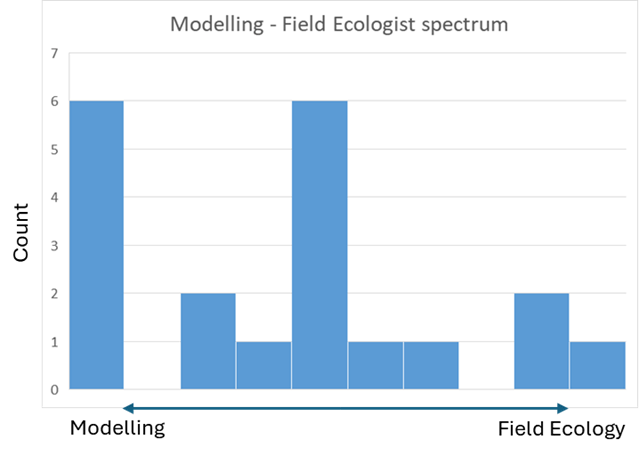
How many regularly do field work/modelling and where do they lie on this spectrum?
Of 20 respondents to our survey, 60% said they regularly do field work, and 80% modelling. They also spanned the range of the modelling – field ecologist spectrum:
What are their challenges?
Both field ecology and modelling can be challenging in different ways. When in the field, hours may be long, which may put off some:
“I would probably have been a field ecologist if I could be home for dinner every day.”
It can also be physically and psychologically challenging, “requiring vision, belief, optimism, determination, and considerable logistical skills”.
On the other hand, “the investment, planning and time that goes into modelling is often underestimated…”, and it is becoming increasingly complex, which may mean that “it is challenging to develop all the necessary skill sets even over the duration of a PhD, let alone a Masters or BSc.”
How can they help each other?
Field work and modelling can have a mutual or symbiotic relationship. Knowledge and understanding from one can be used to inform the other and vice versa. For example, field work can inform theories that can be quantitively tested with models: it “gives important context for theorising and analysing the natural world, provides many opportunities for hypothesis generation and novel observations”. Modelling can feedback the results of hypothesis testing and test new ideas, which can then be understood or explained by researchers with deep biological knowledge of the system. Model predictions can also be checked through new observations from the field.
Contact between the two can “enrich[es] the discussion and increase[es] the quality of both data gathering and modelling.”
What are the hindrances in working together?
Perhaps one of the largest hindrances can be “when both sides have never or rarely experienced the other side (i.e. field ecologist with no experience in modelling, or a modeller that has never set foot in the field)”. This can lead to a lack of understanding about the limitations and strengths of both, lead to different expectations and mean that “the two fields do not always understand the importance of the other”. Differences in language and specialist terms can also cause difficulties.
What counts as modelling anyway?
As seen from the survey responses, modelling can be seen in different ways. Maybe it’s time to widen our understanding and definition of what modelling is. If you’re a biologist with a hypothesis or a researcher working on data analysis, you may be a modeller!
“I think all biologists are modellers (if they use hypotheses), mathematical modellers just write the hypothesis down and check it makes sense.”
“The line between modelling and data analysis is a very fine one these days.”
What can we all do better going forward?
So perhaps all that is needed is a better understanding of each-other:
“We approach problems with a different perspective and set of skills. A better understanding (from each side) about what the other side is actually able to achieve would probably improve working relationships and research outcomes.”
How do we go about that? Should modellers take trips into the field, should field ecologists try their hands at models?
“In general, it is easy to imagine taking a modeller on a field trip, at least for a short time, to familiarise them with the data collection that their own analyses depend on. It’s rather harder (for me at least) to imagine the equivalent process happening in reverse, having a field ecologist work in modelling for a short time in order to better understand the analytical processes that their own research likewise requires.”
This is a call for us all to think about how people with different expertise can be supported and encouraged to work together towards joint goals for the benefit of all.
Take home message
“It is increasingly difficult for any one person to cover all the bases. Team science is increasingly the only way to go.” And just like siblings who need to get the chores done at home, all hands need to be on deck!
A big thank you to all those who took their time to answer our survey!
This blog post was written by Holly Niven and edited by Praise Adeyemo, Holly designed the original survey, Holly and Praise analysed the survey responses and were supported by the rest of the Naturally Speaking team. The blog cover photo is an AI generated image, created using image generator in ChatGPT.
 Naturally Speaking